
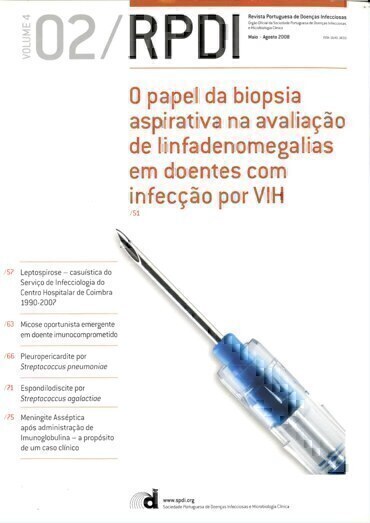
The role of fine-needle aspiration biopsy in the evaluation of lymphadenopathy in HIV-infected patients
DOI:
https://doi.org/10.65332/rpdi.v4.321Keywords:
Lymphadenopathy, fine-needle aspiration biopsy, HIVAbstract
Lymphadenopathy is a very common clinical finding in HIV-infected patients. In Portugal, where tuberculosis remains the main AIDS defining opportunistic infection, the etiologic diagnosis of enlarged lymph nodes is a major problem. Fine-needle aspiration biopsy (FNAB) of enlarged lymph nodes is a simple technique that can be performed on an outpatient basis and the collected material is suitable for cytologic and microbiologic studies. In this study of 524 samples, obtained from patients with moderate/severe immunodeficiency – mean CD4 cell count 330±231 cells/mm³ – this procedure established the diagnosis of lymph node tuberculosis in 120 (23%) cases. Most samples (55%) were consistent with reactive lymphoid hyperplasia. Lymphoma, confirmed by excisional biopsy, was diagnosed in 10 patients. In 96 (18%) samples the obtained material was considered inconclusive or insufficient for a cytologic diagnosis. Fine needle aspiration biopsy was found to be a simple, safe and reliable evaluating procedure for lymphadenopaties in HIV-infected patients, sparing, for most patients, a lymph node excision. A major opportunistic infection, tuberculosis, could be correctly identified and promptly treated.
References
Centro de Vigilância Epidemiológica das Doenças Transmissíveis; Doc. 138, Junho 2007
Gleeson M, Herbert A, Richards A, "Management of lateral neck masses in adults” BMJ 320:1521-4, 2000
Gupta AK, Nayar M, Chandra M. "Reliability and limitations of fine needle aspiration cytology of jymphadenopathies.” Acta Cytol 35:777-83, 1991
Ramzy, Rone R, Schultenover SJ et al. "Lymph node aspiration biopsy Diagnostic reliability and limitations - an analysis of 350 cases." Diagn Cytopatho! 1:39-45, 1985
Hsu SM, Raine L, Fanger H. "A comparative study of the peroxidase-antiperoxidase method and an avidin-biotin complex method for studying polypeptide hormones with radioimmunoassay antibodies." Am J Clin Pathol 75:734-8, 1981
Nolte FS, Metchock B: Mycobacterium in manual of Clinical Microbiology, Murray PR, Baron E, Pfaller MA, Tenover FC e Yolken RH, 6º Edition, Washington DC, American Society for Microbiology: 400-37, 1995
Chaisson RE, Schecter GF, Theuer CP, et al. “Tuberculosis in patients with the Acquired Immunodeficiency Syndrome. Clinical features, response to therapy and survival." Am Rev Resp Dis 136:570-4, 1987
Shafer RW, Kim DS, Weiss JP, et al "Extrapulmonary tuberculosis in patients with Human Immunodeficiency Virus infection." Medicine 70:384-97, 1991
Bem C, Patil PS, Bharucha H, et al. “Importance of human immunodeficiency virus-associated lymphadenopathy and tuberculous lymphadenitis in patients undergoing lymph node biopsy in Zambia." Br J Surg 83:75-8, 1996
Bottles K, McPhaul LW, Volberding P "Fine-needle aspiration biopsy of patients with the acquired immunodeficiency syndrome (AIDS): experience in an outpatient clinic.” Ann intern Med 108:42-5, 1988
Grossi NA, Mosunjac MI, Wallace TM. "Utility of fine needle aspiration in HIV-positive patients with corresponding CD4 counts. Four years experience in large inner city hospital.” Acta Cytol 41:811-6, 1997
Dandapat MC, Mishra BM, Dash SP et al “Peripheral lymph node tuberculosis: a review of 80 cases.” Br J Surg 77:911-2, 1990
Llatjos M, Romeu J, Clotet B, et al. “A distinctive cytologic pattern for diagnosing tuberculous lymphadenitis in AIDS.” J Acquir immune Defic Syndr 6:1335-8, 1993
Lee KC, Tami TA, Lalwani AK, Schecter G "Contemporary management of cervical tuberculosis" Laryngoscope 102:60-4, 1992
Lau SK, Wei WI, Hsu C, et al. “Efficacy of fine needle aspiration cytology in the diagnosis of tuberculosis lymphadenopathy." J Laryngol Otol 104:24-7, 1990
Downloads
Published
Issue
Section
License
Copyright (c) 2008 A. Ferreira, R. Serrão, R. Marques, S. Silva, S. Xerinda, C. Piñeiro, A. Prisca, S. Rocha Silva, I. Amendoeira, H. Barroca, D. Pinheiro, T. Carvalho, A. Sarmento (Autor)

This work is licensed under a Creative Commons Attribution 4.0 International License.


