
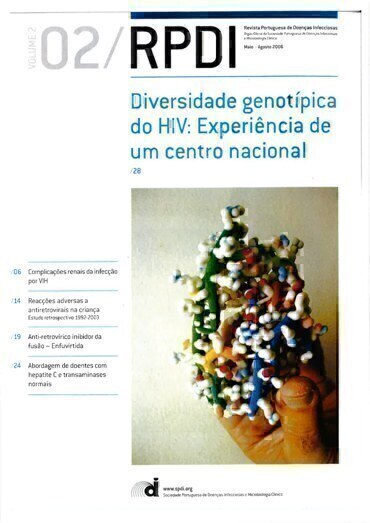
Adverse Reactions to Antiretroviral Drugs in Children
A Retrospective Study, 1992–2003
DOI:
https://doi.org/10.65332/rpdi.v2.286Keywords:
human immunodeficiency virus, antiretroviral therapy, adverse eventsAbstract
Introduction: The use of new therapeutic regimens in human immunodeficiency virus (HIV)-infected children has greatly improved survival. Simultaneously antiretroviral toxicity is an increasingly important issue in the management of these patients.
Objective: To evaluate the incidence of adverse events attributed to antiretroviral therapy in HIV-infected children. Methods: Retrospective study with review of clinical data from HIV-infected children under antiretroviral therapy.
Results: In our study, 31 (65%) of the 48 children were female, 30 (62%) were caucasian, and the median age was 6 years. The adverse events reported were: Zidovudine – anaemia, 4/43; Nevirapine – Stevens-Johnson syndrome, 1/11; Indinavir – renal lithiasis, 1/3 and retinoid-like effect, 1/3; Ritonavir – gastro-intestinal intolerance, 3/19 and Ritonavir/Lopinavir solution – dissulfiram-like reaction, 1/19; didanosine – rash, 1/42 and increase in serum pancreatic amylase, 2/42; nelfinavir – severe diarrhoea, 1/44. Besides this, we detected dislipidemia, 13/48, hyperlactatemia, 4/48 and increases in serum gamma-glutamyl transferase, 3/48, which could not be associated to a specific antiretroviral. In 11 out of 35 cases the adverse reaction led to the suspension of the medication, after what the clinical manifestations disappeared, in all cases. We did not find any relation between the occurrence of the adverse events and the race of the children, nor between such effects and their age when they began antiretroviral therapy.
Conclusions: Half of the children presented at least one adverse reaction. Therapeutics of HIV infected children is strongly conditioned by antiretroviral toxicity, however, this doesn't outweigh the advantages of its use.
References
Carr A, Cooper DA. Adverse effects of antiretroviral therapy. Lancet 2000; 356: 1423-30.
Working Group on Antiretroviral Therapy and Medical Management of HIV-Infected Children. Guidelines for the Use of Antiretroviral Agents in Pediatric HIV Infection 2004. Available at: http://aidsinfo.nih.gov. Accessed on 2005-02-09.
Gray L, Newell ML, Thorne C, et al. Fluctuations in symptoms in HIV-infected children: the first 10 years of life. Pediatrics 2001. 108(1):116-22
Dieterich D, Robinson P, Love J, Stern J. Drug-Induced Liver Injury Associated with the Use of Nonnucleoside Reverse-Transcriptase Inhibitors CID 2004:38 (Suppl 2):S80 9.
Cvetkovic RS, Goa KL. Lopinavir/Ritonavir, a review of its use in the management of HIV infection. Drugs 2003; 63(8):769-802.
Clotet B, Negredo E. HIV Protease Inhibitors and Dyslipidemia. AIDS Rev 2003;5:19-24.
Fleischer R, Boxwell D, and Sherman KE. Nucleoside Analogues and Mitochondrial Toxicity. Brief Report CID 2004;38:79-80
Zidovudine Oral, Adverse Effects List and Discussion. Available at: http://www.medscape.com/druginfo. Accessed on 2003-06-13.
Pollard RB, Robinson P, Dransfield K. Safety Profile of Nevirapine, a NNRTI for the Treatment of HIV Infection. Clinical Therapeutics 1998. 20(6):1071-92.
Tershakovec AM, Rader DJ. Disorders of Lipoprotein Metabolism and Transport. In: Behrman RE, Kliegman RM, Jenson HB, eds. Nelson Textbook of Pediatrics 16th Edition. Philadelphia: WB Saunders Company; 387-98.
Bardsley-Elliot A, Plosker GL. Nelfinavir - An Update on its Use in HIV Infection. Drugs 2000; 59 (3):581-620.
Stockley IHP. Alcohol interactions in Stockley ed. Drug Interactions 3rd Ed. Blackwell Scientific Publications, Oxford 1994: 15-45.
Mueller BU, Nelson RP, Sleasman J, et al. A phase I/II study of the protease inhibitor ritonavir in children with HIV infection. Pediatrics, 1998,101 (3Pt1): 335-43.
Yogev R, Lee S, Wiznia A, et al, for the Pediatric AIDS Clinical Trials Group 338 Study Team. Stavudine, nevirapine and ritonavir in stable antiretroviral therapy-experienced children with HIV infection. Pediatr Infect Dis J. 2002; 21(2): 119-25.
AIDSinfo Drugs Database - Nevirapine. Available at: http://www.aidsinfo.nih.gov/. Accessed on 2003-07-02.
Fagot JP, Mockenhaupt M, Bouwes-Bavinck JN, Naldi L, Viboud C, Roujeau JC. Nevirapine and the risk of Stevens-Johnson syndrome or toxic epidermal necrolysis. AIDS 2001;15 (14): 1843-8.
Hirsch MS, Steigbigel RT, Staszewski S, McMahon D, Fischl MA, Hirschl B, et al. Long-Term Efficacy, Safety, and Tolerability of Indinavir-Based Therapy in Protease Inhibitor-Naive Adults with Advanced HIV Infection. HIV/AIDS CID 2003;37: 1119-24.
Downloads
Published
Issue
Section
License
Copyright (c) 2006 Carla Santos, Sara Martins, José G. Marques, Filipa Prata, Ana Mouzinho, Paula Valente (Autor)

This work is licensed under a Creative Commons Attribution 4.0 International License.


