
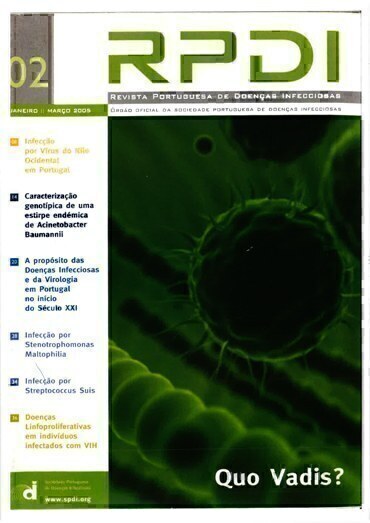
On Infectious Diseases and Virology in Portugal at the Beginning of the 21st Century
DOI:
https://doi.org/10.65332/rpdi.v1.276Keywords:
Infectious Diseases, Portugal, 21st CenturyAbstract
For many years the idea has been spread that infectious diseases were disappearing, and therefore no longer a cause for major concern. Now, fifty years after those ideas appeared for the first time, the HIV virus and other agents have shown that infectious diseases are far from being something from the past. Biological agents are now even ready to be used in warfare, Poliovirus has been synthesized in the laboratory and the whole plan of an eradication concept has to be changed and vaccination against viruses must continue. In this context, entering the XXI century, virology in Portugal has not been given sufficient attention, not only in scientific education in universities and research centers but also in setting up industrial research projects. By contrast, in other countries the funding of virology research has been clearly recognized as still being relevant. The contributions that work in this area has brought to the progress of sciences in general has been considerable, as indicated by the vast number of Nobel prizes awarded during the last century. Under these conditions it is becoming vital to prepare the new generations of young Portuguese university students in order for them to be ready to approach the new challenges of infectious diseases which are already showing on the horizon.
References
Cello, J, Paul, A, Zimmer, E. Chemical synthesis of poliovirus cDNA: generation of infectious virus in the absence of natural template. Science. 2002; 297(5583): 1016-18.
CEVDI, do Instituto Nacional de Saúde Dr. Ricardo Jorge, Trabalhos Publicados, Vol. I, II, III. 1993, 1996, 1999, Águas de Moura.
DHEW Publication: Virology, summaries and recommendations. National Institute of Allergy and Infectious Diseases. Virology Task Force Report, U.S.A. Department of Commerce. DHEW (NIH) 1979; 79:1836.
Diner, T O - Portraits of Viruses: The Viroid. Intervirology. 1984; 22: 1-16.
Garret, L - The Coming Plague, Ed. Farrar, Straus, and Giroux. 1994; New York.
Johnson, R T e Gibbs C J, Jr. - Koch's postulates and slow infections of the nervous system. Arch. Neurol. 1974; 36-38.
Jornal Público, A Herança de Nobel, Edição do Jornal Público. 2001; Lisboa.
Luria, SE - Lectures in Biology. MIT Press. 1975; Cambridge.
Melnick, JL. Portraits of viruses: The Picornaviruses. Intervirology 1983; 20: 1-100.
O.M.S, As Metas da Saúde Para Todos. Edição em português do Ministério da Saúde, 1985. Lisboa.
Prusiner, SB. Novel proteinaceous infectious particles cause scrapie. Science, 1982; 216: 136-44.
Stanley, WM. Isolation of a crystalline protein possessing the properties of Tobacco-Mosaic Virus. Science 1935: 81:644-45.
Weissenbueck, H, Kolodziejek, J, Url, A, Lussy, H, Rebel-Bauder, B, Nowotny, N. Emergence of Usutu virus, an African mosquito-borne Flavivirus of the Japanese encephalitis virus group, Central Europe. Emerging Infectious Diseases. 2002; 8 (7): 652-56.
Williams, JW - From the colloid experiments to DNA (Part II) Fractions, 1974; 28: 1-10.
Downloads
Published
Issue
Section
License
Copyright (c) 2005 Armindo R. Filipe (Autor)

This work is licensed under a Creative Commons Attribution 4.0 International License.


