
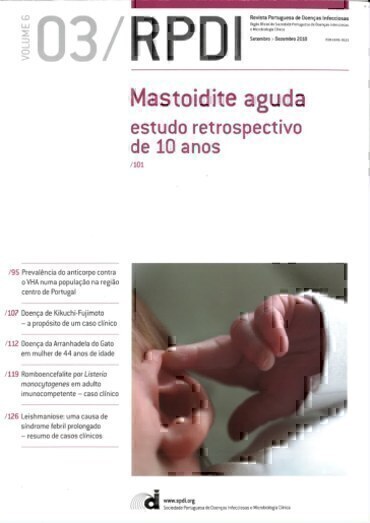
Cat-Scratch disease in a 44-year-old woman
DOI:
https://doi.org/10.65332/rpdi.v6.187Keywords:
Cat-Scratch Disease, Bartonella henselae, Azythromycin, Ctenocephalides felisAbstract
Cat-Scratch Disease (CSD), a zoonosis caused mainly by Bartonella henselae, is transmitted to humans by inoculation into wounds caused by scratches and cat bites. We report a case of CSD of an immunocompetent 44-year-old woman, kitten owner, presenting a papule/crust in a finger of the right hand, regional lymphadenopathies, and treated with azithromycin due to distressful and painful epitrochlear lymphadenopathy. The diagnosis of B. henselae infection was confirmed by serology and by PCR on lymph node biopsy. It was possible also to detect the presence of Bartonella DNA in the cat’s blood but not in the four Ctenecephalides felis fleas collected from the cat. PCR is a useful tool for the characterization of Bartonella species involved in patient infection since there are other emerging species which can also cause the same disease. In Portugal it is urgent to identify which Bartonella species are circulating and are causing disease in humans.
References
Dillon B, Valenzuela J, Don R, Blanckenberg D, Wigney DI, Malik R, et al. "Limited diversity among human isolates of Bartonella henselae". J Clin Microbiol 2002; 40: 4691-4699.
Raoult D, Roblot F, Rolain JM, Besnier JM, Loulergue J, Bastides F, Choutet P. "First isolation of Bartonella alsatica from a valve of a patient with endocarditis". J Clin Microbiol 2006; 44:278–279.
Avidor B, Graidy M, Efrat G, Leibowitz C, Shapira G, Schattner A, Zimhony O, Giladi M. "Bartonella koehlerae, a new cat-associated agent of culture-negative human endocarditis". J Clin Microbiol 2004; 42:3462–3468.
Zeaiter Z, Fournier PE, Raoult D. "Genomic variation of Bartonella henselae strains detected in lymph nodes of patients with Cat-Scratch Disease". J Clin Microbiol 2002; 40: 1023-1030.
Chomel BB, Boulois HJ, Maruyama S, et al. "Bartonella spp in pets and effect on human health". Emerg Infect Dis 2006; 12: 389-394.
Carithers HA. "Cat-Scratch disease: an overview based on a study of 1200 patients". Am J Dis Child 1985; 139: 1124-1133.
Alves AS, Milhano N, Santos-Silva M, Santos AS, Vilhena M, de Sousa R. "Evidence of Bartonella spp, Rickettsia spp and Anaplasma phagocytophilum in domestic, shelter and stray cat blood and fleas, Portugal". Clinical Microbiol Infection 2009; vol 15, suppl 1: 1-3.
Pons I, Sanfeliu I, Nogueras MM, et al. "Seroprevalence of Bartonella spp infection in HIV patients in Catalonia, Spain". BMC Infect Dis 2008; 8: 58-63.
Slater NL, Welch DF. "Bartonella, including Cat-Scratch Disease". In Mandell GL, Bennet JE, Dolin R. eds. Mandell, Douglas, and Bennett’s Principles and Practice of Infectious Diseases (6thed) Philadelphia: Elsevier Churchill Livingstone. 2005: 2733-2748.
Koton CN. "Zoonosis in solid organ and hematopoietic stem cell transplant recipients". Clin Infect Dis 2007; 44: 857-866.
Malatack JJ, Jaffe R. "Granulomatous hepatitis in three children due to catscratch disease without peripheral adenopathy: an unrecognized cause of fever of unknown origin". Am J Dis Child 1993; 147: 949-953.
Florin TA, Zaoukis TE, Zaoutis LB. "Beyond Cat-Scratch Disease: widening spectrum of Bartonella henselae infection". Pediatrics 2008; 121: e1413-e1425.
Hadfield TL, Malatay RH, Van Dellen A, Wear DJ, Margileth AM. "Electron microscopy of the bacilli causing cat-scratch disease". J Infect Dis 1985; 152: 643-645.
Margileth AM. "Recent advances in diagnosis and treatment of cat-scratch disease". Curr Infect Dis Rep 2000; 2: 141-146.
Bass JW, Freitas BC, Freitas AD, et al. "Prospective randomized double-blind placebo-controlled evaluation of azithromycin for treatment of cat-scratch disease". Pediatr Infect Dis J 1998; 17: 447- 452.
Santos R, Cardoso O, Rodrigues P, et al. "Bacillary angiomatosis by Bartonella quintana in an HIV-infected patient". J Am Acad Dermatol 2000; 42: 299- 301.
David de Morais JA, Bacellar F, Filipe A. "Doença da arranhadura do gato com compromisso ósseo em indivíduo imunocompetente: uma forma rara de evolução". Revista Portuguesa Doenças Infecciosas 1997; 20: 48-53.
Cordero A, Escoto V, Lopes L. "Endocardite por Bartonella: um caso de endocardite com culturas negativas". Revista da Sociedade Portuguesa de Medicina Interna 2008; 15 (3): 186 – 191.
Downloads
Published
Issue
Section
License
Copyright (c) 2010 N. Murinello, A. Murinello, H. Damásio, A. Carvalho, R. de Sousa (Autor)

This work is licensed under a Creative Commons Attribution 4.0 International License.


