
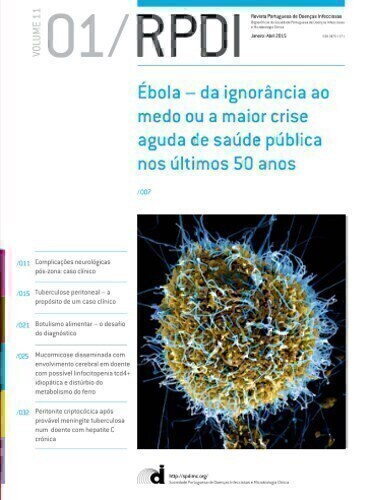
Ebola – from ignorance to fear or the worst acute public health crises in 50 years
DOI:
https://doi.org/10.65332/rpdi.v11.264Keywords:
Ebola, West Africa, EpidemicAbstract
One year since the begin of Ebola virus disease (EVD) outbreak in West Africa, the worst Ebola epidemic in history is ongoing. The epidemic began in Guinea during December 2013 and expanded to Sierra Leone and Liberia. The first cases of EVD, previously designated Ebola haemorrhagic fever were reported in 1967. Similar cases of haemorrhagic fever were described in 1976 from outbreaks in Sudan and Zaire. Five distinct species of Ebola virus were described (Sudan, Zaire, Tai Forest, Bundibuyo and Reston), and EVD remains a plague for the population of equatorial Africa. Almost all human cases are due to Sudan and Zaire Ebola virus. EVD is thought to be a classic zoonosis with persistence of the Ebola virus in a reservoir species, generally bats. Apes and man are regarded as end hosts. Human-tohuman transmission leads to outbreaks, and EVD is spread mainly through the contact of body fluids of patients and cadavers. EVD follows an incubation period of 2-21 days and is characterized by fever, vomiting and severe diarrhea, having case-fatality rates of 50-80%. Ebola virus has a broad cell tropism with release of cytokines and other proinflamatory cellular mediators, leading to multiorgan failure. There is currently no licensed prophylaxis or treatment for EVD; therefore, treatment is merely supportive. The diagnostic of EVD is suspected in a patient with fever, and other main clinical manifestations of EVD, who have risk exposure to the Ebola virus inside or outside the geographic areas of EVD. Laboratory diagnosis is achieved primary by detection of viral particles, or particle components (PCR and antigen detection ELISA) and secondary by measurement of host-specific immune response to infection (a IgM or rising IgG titre constitutes a presumptive diagnosis). Case management is based on isolation of patients and strict barrier nursing procedures. In Africa, traditional funerals and caretaking methods contribute to the spread of the virus and potentiate outbreaks, and should be handled according to avoid the risk to Ebola virus exposure.
References
WHO Ebola situation report. http://apps.who.int/ ebola/en/ebola-situation-report/situation-reports/ ebola-situation-report-11-february-2015
Drazen JM, Campion EW, Rubin EJ, et al. Ebola in West Africa at one year - from ignorance to fear to roadblocks. N Engl J Med 2015; 372: 563-4
Feldman H, Geisbert TW. Ebola hemorragic fever. Lancet 2011; 377: 849-62
Feldman H. Ebola – a growing threat? N Engl J Med 2014; 371: 1375-8
WHO Ebola Response Team. Ebola virus disease in West Africa – the first 9 months of the epidemic and forward projections. N Engl J Med 2014; 371: 1481-95
Balize S, Pannetier D, Oetereich L, et al. Emergence of Zaire Ebola virus disease in Guinea. N Engl J Med 2014; 371: 1418-25
Kreuels B, Wichman D, Emmerich P, et al. A case of severe Ebola virus infection complicated by Gram – negative septicemia. N Engl J Med 2014; 371: 2394-401
Rubin EJ, Baden LR. Out of Africa – caring for patients with Ebola. N Engl J Med 2014; 371: 2430-2
Cox E, Borio L, Temple R. Evaluating Ebola therapies – the case for RCTs. N Engl J Med 2014; 371: 2350-1
Kanapathipillai R, Restrepo AMH, Fast P, et al. Ebola vacine – an urgent international priority. N Engl J Med 2014; 371: 2249-51
Downloads
Published
Issue
Section
License
Copyright (c) 2015 F. Antunes (Autor)

This work is licensed under a Creative Commons Attribution 4.0 International License.


