
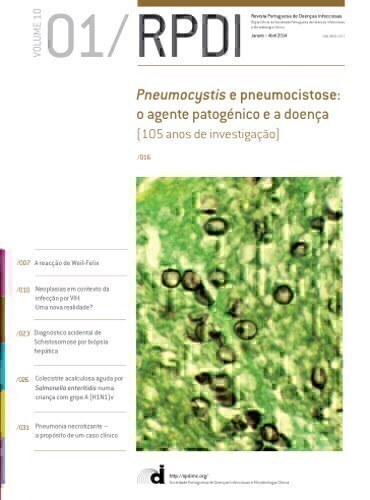
Pneumocystis and pneumocystosis: the pathogen and the disease (105 years of research)
DOI:
https://doi.org/10.65332/rpdi.v10.260Keywords:
Pneumocystis jirovecii, PcP (Pneumocystis pneumonia or pneumocystosis), HIV/AIDS, epidemiology, diagnosisAbstract
Pneumocystis jirovecii pneumonia (pneumocystosis or PcP) is a significant cause of morbidity and mortality in human immunodeficiency virus/acquired immunodeficiency syndrome (HIV/AIDS) patients. PcP is also an emerging problem among HIV seronegative immunocompromised patients due to the rising number of patients receiving immunosuppressive therapies. In the 1980s, along with the HIV/AIDS epidemic, PcP was the cause of one third of the AIDS-indicative diseases diagnosed. In those days, 80% of the HIV-infected patients had at least one episode of PcP that in 20 to 25% of the cases led to death. In the 1990s, the widespread of the anti-P. jirovecii chemoprophylaxis and the highly active antiretroviral therapy (HAART) allowed the improvement of PcP control in the U.S.A and Western Europe. However, a significant percentage of the PcP cases worldwide demonstrate the difficulties of some populations or social groups to access appropriate healthcare services. Several methods have been established for the diagnosis of PcP, including cytochemical staining, immunofluorescent staining with monoclonal antibodies, and molecular techniques. Those methods require resources and specialized personnel. Recently, some candidate molecules have been studied in order to develop a diagnostic method using less invasive samples, such as blood.
References
Barry SM, Johnson MA. “Pneumocystis carinii pneumonia: a review of current issues in diagnosis and management”. HIV Med. 2001;2:123-132. DOI: https://doi.org/10.1046/j.1468-1293.2001.00062.x
Morris A, Lundgren JD, Masur H, et al. “Current epidemiology of Pneumocystis pneumonia”. Emerg Infect Dis. 2004;10:1713- 1720. DOI: https://doi.org/10.3201/eid1010.030985
Matos O, Costa MC, Correia I, et al. “Pneumocystis jiroveci infection in immunocompetent patients with pulmonary disorders, in Portugal”. Acta Med Port. 2006;19:121-126.
Calderón EJ, Gutiérrez-Rivero S, Durand- Joly I, Dei-Cas E. “Pneumocystis infection in humans: diagnosis and treatment”. Expert Rev Anti Infect Ther. 2010;8:683-701. DOI: https://doi.org/10.1586/eri.10.42
Redhead SA, Cushion MT, Frenkel JK, Stringer JR. “Pneumocystis and Trypanosoma cruzi: nomenclature and typifications”. J Eukaryot Microbiol. 2006;53:2-11. DOI: https://doi.org/10.1111/j.1550-7408.2005.00072.x
Aliouat-Denis CM, Chabe M, Demanche C, et al. “Pneumocystis species, co-evolution and pathogenic power”. Infect Genet Evol. 2008;8:708-726. DOI: https://doi.org/10.1016/j.meegid.2008.05.001
European Centre for Disease Prevention and Control (ECDC), World Health Organization (WHO). 2013. HIV/AIDS surveillance in Europe 2012. (http://www.euro.who.int/__data/ assets/pdf_file/0018/235440/e96953.pdf)
Chagas C. “Nova tripanozomiaza humana”. Mem Inst Oswaldo Cruz (Rio de Janeiro). 1909;1:159-218. DOI: https://doi.org/10.1590/S0074-02761909000200008
Carini A. “Formas des eschizogonia do Trypanosoma lewisi”. Soc Med Cir São Paulo. 1910;38:8.
Delanoë P, Delanoë M. “Sur les rapports des kystes de Carini du poumon des rats avec le trypanosoma Lewisii”. C R Acad Sci (Paris). 1912;155:658-660.
Vavra J, Kucera K. “Pneumocystis carinii delanoe, its ultrastructure and ultrastructural affinities”. J Protozool. 1970;17:463-483. DOI: https://doi.org/10.1111/j.1550-7408.1970.tb04715.x
Van der Meer G, Brug SL. “Infection par Pneumocystis chez l’homme et chez les animaux”. Ann Soc Belg Med Trop. 1942 ;22:301-307.
Gajdusek DC. “Pneumocystis carinii as the cause of human disease: historical perspective and magnitude of the problem: introductory remarks”. Natl Cancer Inst Monogr. 1976;43:1-11.
Vanek J. “Atypicka (interstitiálni) pneumonie detí vyvolaná Pneumocystis carinii (atypical interstitial pneumonia of infants produced by Pneumocystis carinii)”. Casop lék cesk. 1951;90:1121–4.
Jírovec O. “Pneumocystis carinii puvodce t. zv intertitialnich plasmocelularnich pneumonii kojencw (Pneumocystis carinii, the cause of interstitial plasmacellular pneumonia in neonates)”. Csl Hyg epid mikrob. 1952;1:141.
Frenkel JK. “Pneumocystis pneumonia, an immunodeficiency-dependent disease (IDD): a critical historical overview”. J Eukaryot Microbiol. 1999;46:89S-92S.
Hughes WT, McNabb PC, Makres TD, Feldman S. “Efficacy of trimethoprim and sulfamethoxazole in the prevention and treatment of Pneumocystis carinii pneumonitis”. Antimicrob Agents Chemother. 1974;5:289-293. DOI: https://doi.org/10.1128/AAC.5.3.289
Centers for Disease Control and Prevention (CDC). “Pneumocystis Pneumonia --- Los Angeles”. Morbidity and Mortality Weekly Reports (MMWR). 1981;30(21):1-3.
Wachter RM, Luce JM, Turner J, Volberding P, Hopewell PC. “Intensive care of patients with the acquired immunodeficiency syndrome. Outcome and changing patterns of utilization”. Am Rev Respir Dis. 1986;134:891- DOI: https://doi.org/10.1164/arrd.1986.134.5.891
Dohn MN, Baughman RP, Vigdorth EM, Frame DL. “Equal survival rates for first, second, and third episodes of Pneumocystis carinii pneumonia in patients with acquired immunodeficiency syndrome”. Arch Intern Med. 1992;152:2465-2470. DOI: https://doi.org/10.1001/archinte.1992.00400240083014
Fischl MA, Dickinson GM, La VL. “Safety and efficacy of sulfamethoxazole and trimethoprim chemoprophylaxis for Pneumocystis carinii pneumonia in AIDS”. JAMA. 1988;259:1185-1189. DOI: https://doi.org/10.1001/jama.1988.03720080019021
Delmas MC, Schwoebel V, Heisterkamp SH, et al. “Recent trends in Pneumocystis carinii pneumonia as AIDS-defining disease in nine European countries. Coordinators for AIDS Surveillance”. J Acquir Immune Defic Syndr Hum Retrovirol. 1995;9:74-80. DOI: https://doi.org/10.1097/00042560-199505010-00011
Kaplan JE, Hanson D, Dworkin MS, et al. “Epidemiology of human immunodeficiency virus-associated opportunistic infections in the United States in the era of highly active antiretroviral therapy”. Clin Infect Dis. 2000;30 Suppl 1:S5-14. DOI: https://doi.org/10.1086/313843
Weverling GJ, Mocroft A, Ledergerber B, et al. “Discontinuation of Pneumocystis carinii pneumonia prophylaxis after start of highly active antiretroviral therapy in HIV-1 infection. EuroSIDA Study Group”. Lancet. 1999;353:1293–8. DOI: https://doi.org/10.1016/S0140-6736(99)03287-0
Mocroft A, Katlama C, Johnson AM, et al. AIDS across Europe, 1994-98: the EuroSIDA study”. Lancet. 2000;356:291-296. DOI: https://doi.org/10.1016/S0140-6736(00)02504-6
Matos O. “Pneumocystis jirovecii pneumonia in Africa: impact and implications of highly sensitive diagnostic technologies”. N Am J Med Sci. 2012;4:486-487.
Walzer PD, Evans HE, Copas AJ, et al. “Early predictors of mortality from Pneumocystis jirovecii pneumonia in HIV-infected patients: 1985-2006”. Clin Infect Dis. 2008;46:625-633. DOI: https://doi.org/10.1086/526778
Smulian AG, Sullivan DW, Linke MJ, et al. “Geographic variation in the humoral response to Pneumocystis carinii”. J Infect Dis. 1993;167:1243-1247. DOI: https://doi.org/10.1093/infdis/167.5.1243
Joint United Nations Programme on HIV/ AIDS (UNAIDS). Global report: UNAIDS report on the global AIDS epidemic 2013. WHO Library Cataloguing-in-Publication Data. UNAIDS / JC2502/1/E. (http://www.unaids.org/en/media/unaids/ contentassets/documents/epidemiology/2013/ gr2013/UNAIDS_Global_Report_2013_en.pdf)
de Armas Rodríguez Y, Wissmann G, Müller AL, et al. “Pneumocystis jirovecii pneumonia in developing countries”. Parasite. 2011;18(3):219-28. DOI: https://doi.org/10.1051/parasite/2011183219
Calderón EJ, de Armas Y, Panizo MM, Wissmann G. “Pneumocystis jirovecii pneumonia in Latin America. A public health problem?” Expert Rev Anti Infect Ther. 2013;11(6):565-70. DOI: https://doi.org/10.1586/eri.13.41
Malin AS, Gwanzura LK, Klein S. et al. “Pneumocystis carinii pneumonia in Zimbabwe”. Lancet. 1995;346:1258-1261. DOI: https://doi.org/10.1016/S0140-6736(95)91862-0
Worodria W, Okot-Nwang M, Yoo SD, Aisu T. “Causes of lower respiratory infection in HIV-infected Ugandan adults who are sputum AFB smear-negative”. Int J Tuberc Lung Dis. 2003;7:117-123.
Armstrong W, Meshnick S, Kazanjian P. “Pneumocystis carinii mutations associated with sulfa and sulfone prophylaxis failures in immunocompromised patients”. Microbes Infect. 2000;2:61-67. DOI: https://doi.org/10.1016/S1286-4579(00)00284-7
Esteves F, Gaspar J, de Sousa B, et al. “Pneumocystis jirovecii multilocus genotyping in pooled DNA samples: A new approach for epidemiological and clinical studies”. Clin Microbiol Infect. 2012;18:E177-E184. DOI: https://doi.org/10.1111/j.1469-0691.2012.03828.x
Tasaka S, Hasegawa N, Kobayashi S, et al. “Serum indicators for the diagnosis of Pneumocystis pneumonia”. Chest. 2007;131(4):1173-80. DOI: https://doi.org/10.1378/chest.06-1467
de Boer MG, Gelinck LB, van Zelst BD, et al. “-D-glucan and S-adenosylmethionine serum levels for the diagnosis of Pneumocystis pneumonia in HIV-negative patients: a prospective study”. J Infect. 2011;62(1):93-100. DOI: https://doi.org/10.1016/j.jinf.2010.10.007
Downloads
Published
Issue
Section
License
Copyright (c) 2014 F. Esteves, F. Antunes, O. Matos (Autor)

This work is licensed under a Creative Commons Attribution 4.0 International License.


