
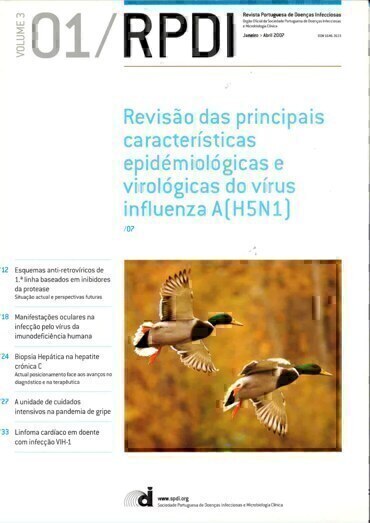
A unidade de cuidados intensivos na pandemia de gripe
DOI:
https://doi.org/10.65332/rpdi.v3.301Palavras-chave:
pandemia, gripe das aves, cuidados intensivosResumo
Os AA debruçam-se sobre o problema da capacidade de resposta das Unidades de Cuidados Intensivos (UCI), durante a previsível pandemia de gripe, perante um elevado número de doentes que necessitarão de suporte ventilatório. Estabelecem comparações com anteriores surtos epidémicos, com outras agressões biológicas e com outras situações de catástrofe. Preconizam o aumento da capacidade de resposta das UCI durante a fase pandémica, segundo dois vectores de actuação: a triagem dos doentes que necessitam de ventilação mecânica e a expansão e "projecção" das UCI. Apesar da impossibilidade prática da existência de ventiladores para todos, há que tentar salvar o maior número possível de doentes críticos, tratando-os fora das UCI.
Referências
Gruber PC, Gomersall CD, Joynt GM. Avian influenza (H5N1): implications for intensive care. Intensive Care Med 2006; 32(6): 823-829.
Booth CM, Stewart TE. Severe acute respiratory syndrome and critical care medicine: the Toronto experience. Crit Care Med 2005; 33 (1 Suppl): S53-60.
Scales DC, Green K, Chan AK, Poutanen SM, Foster D, Nowak K, Raboud JM, Saskin R, Lapinsky SE, Stewart TE. Illness in intensive care staff after brief exposure to severe acute respiratory syndrome. Emerg Infect Dis 2003; 9:1205-1210.
Fowler RA, Guest CB, Lapinsky SE, Sibbald WJ, Louie M, Tang P, Simor AE, Stewart TE. Transmission of severe acute respiratory syndrome during intubation and mechanical ventilation. Am J Respir Crit Care Med 2004; 169:1198-1202.
Hugonnet S, Pittet D. Transmission of severe acute respiratory syndrome in critical care: do we need a change? Am J Respir Crit Care Med 2004; 169(11): 1177-1178.
Hick John L, O'Laughlin Daniel T. Concept of Operations for Triage of Mechanical Ventilation in an Epidemic. Acad Emerg Med 2006; 13:223-229.
WHO pandemic influenza draft protocol for rapid response and containment; 2006; www.who.int/csr/disease/avian_influenza/guidelines/RapidResponse_27%2001.pdf
Responding to the avian influenza pandemic threat. Recommended strategic actions. WHO, Communicable Disease Surveillance and Response/ Global Influenza Programme; 2004 www.who.int/csr/resources/publications/influenza/WHO_CDS_CSR_GIP_05_8-EN.pdf .
Fowler RA, Lapinsky SE, Hallett D, Detsky AS, Sibbald WU, Slutsky AS, Stewart TE; Toronto SARS Critical Care Group. Critically ill patients with severe acute respiratory syndrome. JAMA 2003; 290(3): 367-373.
Manocha S, Walley KR, Russell JA. Severe acute respiratory distress syndrome (SARS): a critical care perspective. Crit Care Med 2003; 31(11): 2684-2692.
Lew TW, Kwek TK, Tai D, Earnest A, Loo S, Singh K, Kwan KM. Chan Y, Yim CF, Bek SL, Kor AC, Yap WS, Chelliah YR, Lai YC, Goh SK.Acute respiratory distress syndrome in critically ill patients with severe acute respiratory syndrome. JAMA 2003; 290(3): 374-380.
Lapinsky SE, Hawryluck L. ICU management of severe acute respiratory syndrome. Intensive Care Med 2003; 29(6): 870-875.
Laura Hawryluck, Stephen E Lapinsky Thomas E Stewart; Clinical review: SARS - lessons in disaster management. Crit Care 2005; 9:384-389.
Gavin M. Joynt, Hy Yap; SARS in the Intensive Care Unit. Curr Infect Dis Rep 2004; 6:228-233.
Gomersall CD, Joynt GM, Lam P, Li T, Yap F, Lam D, Buckley TA, Sung JJ, Hui DS, Antonio GE, Ahuja AT, Leung P. Short-term outcome of critically ill patients with severe acute respiratory syndrome. Intensive Care Med 2004; 30(3): 381-387.
Christopher M Booth, Thomas E Stewart; Communication in the Toronto critical care community: important lessons learned during SARS. Crit Care 2003; 7:405-406.
Lapinsky SE, Granton JT. Critical care lessons from severe acute respiratory syndrome. Curr Opin Crit Care 2004; 10(1): 53-58.
Dara SI, Ashton RW, Farmer JC. Engendering enthusiasm for sustainable disaster critical care response: why this is of consequence to critical care professionals? Crit Care 2005; 9(2): 125-127.
R-T Gustavo, G René. Pandemic preparedness. In: Influenza Report 2006; Kamps BS, Hoffmann C, Preiser W, editors. Flying Publisher 2006, pg. 110-127.
Sousa JPA. A resposta da UCI na pandemia de gripe. In Medicina de Emergência: dos princípios à organização. Marques A, Sousa JPA, editors. 2006, pg. 81-91.
Parker MM. Critical care and disaster management. Crit Care Med 2006; 34 (3):S52-55.
Roccaforte JD, Cushman JG. Disaster preparation and management for the intensive care unit. Curr Opin Crit Care 2002; 8(6): 607-615.
Rubinson L, Nuzzo JB, Talmor DS, O'Toole T, Kramer BR, Inglesby TV. Augmentation of hospital critical care capacity after bioterrorist attacks or epidemics: recommendations of the Working Group on Emergency Mass Critical Care. Crit Care Med 2005; 33(10):2393-2403.
Gomersall CD, Tai DY, Loo S, Derrick JL, Goh MS, Buckley TA, Chua C, Ho KM, Raghavan GP, Ho OM, Lee LB, Joynt GM. Expanding ICU facilities in an epidemic: recommendations based on experience from the SARS epidemic in Hong Kong and Singapore. Intensive Care Med 2006; 32(7): 1004-1013.
Rubinson L, O'Toole T. Critical care during epidemics. Crit Care 2005; 9(4):311-313.
Downloads
Publicado
Edição
Secção
Licença
Alguns direitos reservados 2007 J. P. A. Sousa, J. Pimentel (Autor)

Este trabalho encontra-se publicado com a Licença Internacional Creative Commons Atribuição 4.0.


