
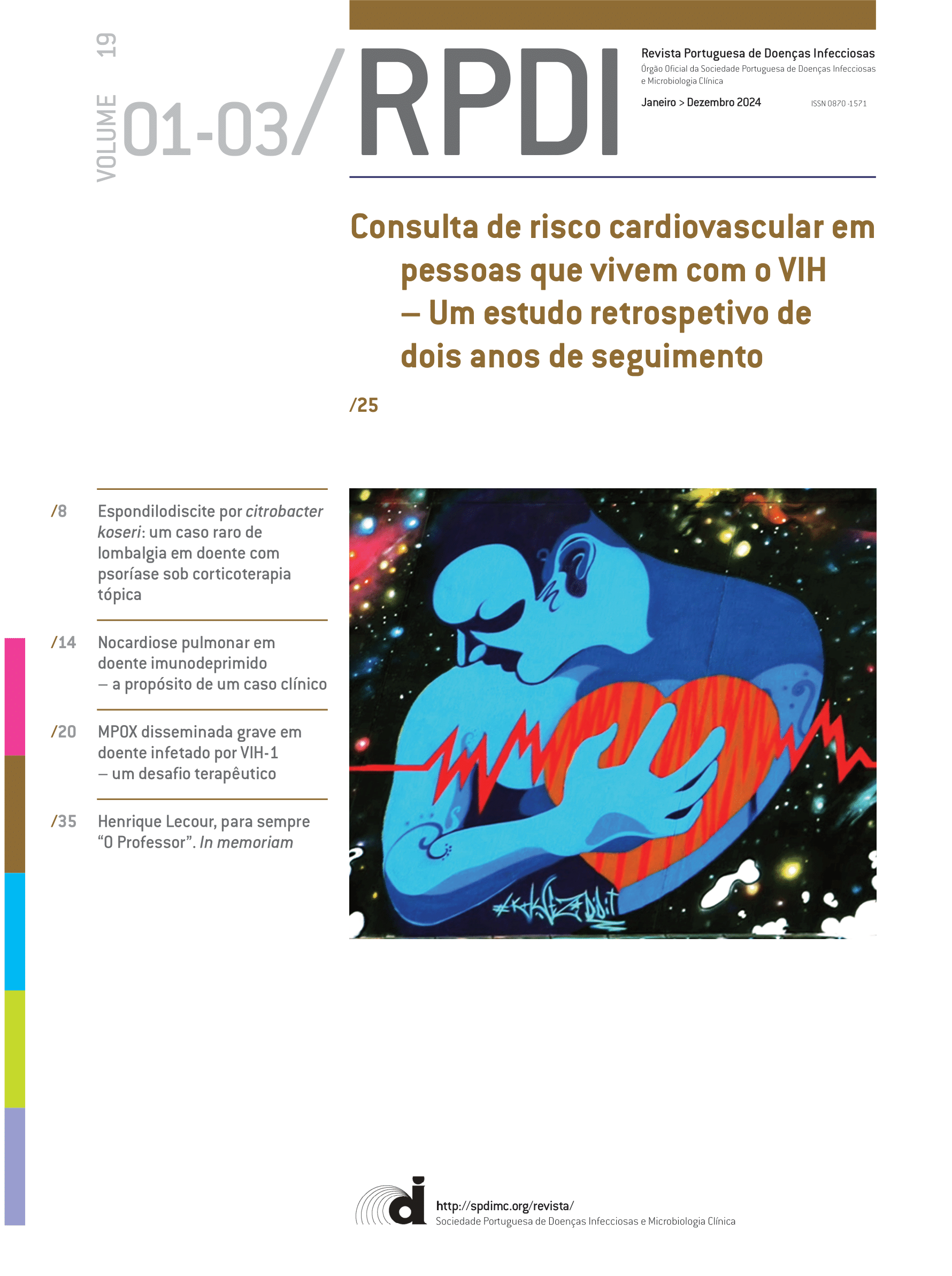
Consulta de risco cardiovascular em pessoas que vivem com o VIH – Um estudo retrospetivo de dois anos de seguimento
DOI:
https://doi.org/10.65332/rpdi.v19.131Palavras-chave:
Vírus da imunodeficiência humana, risco cardiovascular, doença cardiovascularResumo
Introdução: As pessoas que vivem com vírus da imunodeficiência humana (VIH) apresentam uma incidência de doença cardiovascular duas vezes superior à da população em geral. Este risco aumentado parece estar relacionado com o estado de inflamação crónica, com a terapêutica antirretroviral e com a prevalência aumentada de fatores de risco tradicionais.
Métodos: Os autores desenvolveram um estudo observacional retrospetivo de todos os doentes acompanhados na consulta de risco cardiovascular dirigida a pessoas que vivem com VIH do Hospital Garcia de Orta entre outubro de 2021 e junho de 2024. Os dados foram obtidos através da consulta do processo clínico hospitalar e analisados através do software Excel®.
Resultados: Foram incluídos 72 doentes com uma mediana de seguimento de 1,37 anos. A idade mediana foi de 61 anos e 58,3% dos indivíduos eram do sexo masculino; 97,2% apresentavam controlo virológico. A maioria (77,7%) dos doentes apresentava risco cardiovascular elevado ou muito elevado segundo o cálculo do SCORE2. Em relação aos fatores de risco cardiovascular, 62,5% apresentavam sedentarismo, 48,6% tabagismo, 43,1% obesidade, 76,4% obesidade abdominal, 80,6% dislipidemia, 94,4% hipertensão arterial e 37,5% diabetes mellitus. Durante o seguimento, assistiu-se a uma evolução positiva dos níveis de atividade física, dos cuidados com a dieta e tabagismo, assim como do controlo da hipertensão arterial e dislipidemia, mas não da obesidade ou da diabetes mellitus.
Conclusões: A elevada prevalência de fatores de risco cardiovascular e a evolução em geral favorável apresentada durante o seguimento reforçam a necessidade de uma intervenção especializada que permita prevenir e identificar precocemente a doença cardiovascular nesta população.
Referências
Trickey A, McGinnis K, Gill MJ, Abgrall S, Berenguer J, Wyne C, et al. Longitudinal trends in causes of death among adults with HIV on antiretroviral therapy in Europe and North America from 1996 to 2020: a collaboration of cohort studies. The Lancet HIV. 2024 Mar;11(3):e176-e185. doi: 10.1016/S2352-3018(23)00272-2.
Shah ASV, Stelzle D, Lee KK, Beck EJ, Alam S, Clifford S, et al. Global burden of atherosclerotic cardiovascular disease in people living with HIV. Circulation 2018; 138. doi: 10.1161/circulationaha.117.033369.
Delabays B, Cavassini M, Damas J, Beuret H, Calmy A, Hasse B, et al. Cardiovascular risk assessment in people living with HIV compared to the general population. Eur J Prev Cardiol. 2022 Mar 30;29(4):689-699. doi: 10.1093/eurjpc/zwab201.
Longenecker CT, Sullivan C, Baker JV. Immune activation and cardiovascular disease in chronic HIV infection. Curr Opin HIV AIDS. 2016;11:216-225. doi: 10.1097/COH.0000000000000227.
Dirajlal-Fargo S, Funderburg N. HIV and cardiovascular disease: the role of inflammation. Curr Opin HIV AIDS. 2022 September 01; 17(5): 286-292. doi:10.1097/COH.0000000000000755.
Grinspoon S, Carr A. Cardiovascular risk and body-fat abnormalities in HIV-infected adults. N Engl J Med. 2005 Jan 6;352(1):48-62. doi: 10.1056/NEJMra041811.
Hemkens LG, Bucher HC. HIV infection and cardiovascular disease. Eur Heart J. 2014 Jun 1;35(21):1373-81. doi: 10.1093/eurheartj/eht528.
Ryom L, Lundgren JD, El-Sadr W, Reiss P, Kirk O, Law M, et al.; D:A:D study group. Cardiovascular disease and use of contemporary protease inhibitors: the D:A:D international prospective multicohort study. Lancet HIV. 2018 Jun;5(6):e291-e300. doi: 10.1016/S2352-3018(18)30043-3.
Eyawo O, Brockman G, Goldsmith CH, Hull MW, Lear SA, Bennett M, et al. Risk of myocardial infarction among people living with HIV: an updated systematic review and meta-analysis. BMJ Open. 2019;9:e025874. doi: 10.1136/bmjopen-2018-025874.
Djeric K, Baxi SM, Reingold AL, Hubbard A. Risk of cardiovascular events from current, recent, and cumulative exposure to abacavir among persons living with HIV who were receiving antiretroviral therapy in the United States: a cohort study. BMC Infect Dis. 2017 Oct 27;17(1):708. doi: 10.1186/s12879-017-2808-8.
Sax PE, Erlandson KM, Lake JE, Mccomsey GA, Orkin C, Esser S, et al. Weight gain following initiation of antiretroviral therapy: risk factors in randomized comparative clinical trials. Clin Infect Dis. 2020 Sep 12;71(6):1379-1389. doi: 10.1093/cid/ciz999.
Fitch KV. Contemporary lifestyle modification interventions to improve metabolic comorbidities in HIV. Curr HIV/AIDS Rep. 2019 Dec;16(6):482-491. doi: 10.1007/s11904-019-00467-0.
Giles ML, Gartner C, Boyd MA. Smoking and HIV: what are the risks and what harm reduction strategies do we have at our disposal? AIDS Res Ther. 2018 Dec 12;15(1):26. doi: 10.1186/s12981-018-0213-z.
Feinstein MJ, Hsue PY, Benjamin LA, Bloomfield GS, Currier JS, Freiberg MS, et al. Characteristics, prevention, and management of cardiovascular disease in people living with HIV. Circulation. 2019 Jul 9;140(2):e98-e124. doi: 10.1161/CIR.0000000000000695.
Ntsekhe M, Baker JV. Cardiovascular disease among persons living with HIV: New insights into pathogenesis and clinical manifestations in a global context. Circulation. 2023;147:83-100. doi: 10.1161/CIRCULATIONAHA.122.057442.
Alonso A, Barnes AE, Guest JL, Shah A, Shao IY, Marconi V. HIV infection and incidence of cardiovascular diseases: an analysis of a large healthcare database. J Am Heart Assoc. 2019 Jul 16;8(14):e012241. doi: 10.1161/JAHA.119.012241.
Freiberg MS, Chang CH, Skanderson M, Patterson OV, DuVall SL, Brandt CA, et al. Association between HIV infection and the risk of heart failure with reduced ejection fraction and preserved ejection fraction in the antiretroviral therapy era: results from the Veterans Aging Cohort Study. JAMA Cardiol. 2017;2:536-546. doi: 10.1001/jamacardio.2017.0264.
Guaraldi G, Orlando G, Zona S, Menozzi M, Carli F, Garlassi E, et al. Premature age-related comorbidities among HIV-infected persons compared with the general population. Clin Infect Dis. 2011 Dec;53(11):1120-6. doi: 10.1093/cid/cir627.
Kong AM, Pozen A, Anastos K, Kelvin EA, Nash D. Non-HIV comorbid conditions and polypharmacy among people living with HIV age 65 or older compared with HIV-Negative individuals age 65 or older in the United States: A retrospective claims-based analysis. AIDS Patient Care STDS. 2019 Mar;33(3):93-103. doi: 10.1089/apc.2018.0190.
Nasi M, De Biasi S, Gibellini L, Bianchini E, Pecorini S, Bacca V, et al. Ageing and inflammation in patients with HIV infection. Clin Exp Immunol. 2017 Jan;187(1):44-52. doi: 10.1111/cei.12814.
Rodríguez-Penney AT, Iudicello JE, Riggs PK, Doyle K, Ellis RJ, Letendre SL, et al.; HIV Neurobehavioral Research Program HNRP Group. Comorbidities in persons infected with HIV: increased burden with older age and negative effects on health-related quality of life. AIDS Patient Care STDS. 2013 Jan;27(1):5-16. doi: 10.1089/apc.2012.0329.
Greene M, Steinman MA, McNicholl IR, Valcour V. Polypharmacy, drug-drug interactions, and potentially inappropriate medications in older HIV-infected adults. J Am Geriatr Soc. 2014 Mar;62(3):447-53. doi: 10.1111/jgs.12695.
Triant VA, Perez J, Regan S, Massaro JM, Meigs JB, Grinspoon SK, et al. Cardiovascular risk prediction functions underestimate risk in HIV infection. Circulation 2018; 137. doi: 10.1161/CIRCULATIONAHA.117.028975.
Batterham RL, Beddow RJ, Diaz RS, Guaraldi G, Lo J, Martínez E, et al. Cardiometabolic health in people with HIV: expert consensus review. J Antimicrob Chemother. 2024 Jun 3;79(6):1218-1233. doi: 10.1093/jac/dkae116.
Milinkovic A, Pereira B, Mazzitelli M, Girometti N, Asboe D, Pozniak A, et al. Delivering specialised care to people ageing with HIV in the UK: experience and evolution of services from 2009 to 2019. Lancet HIV. 2022 Mar;9 Suppl 1:S1. doi: 10.1016/S2352-3018(22)00066-2.
Guaraldi G, Rockwood K. Geriatric HIV medicine is born. Clin Infect Dis. 2017 Aug 1;65(3):507-509. doi: 10.1093/cid/cix316.
Global Cardiovascular Risk Consortium; Magnussen C, Ojeda FM, Leong DP, Alegre-Diaz J, Amouyel P, Avilés-Santa L, et al. Global effect of modifiable risk factors on cardiovascular disease and mortality. N Engl J Med. 2023 Oct 5;389(14):1273-1285. doi: 10.1056/NEJMoa2206916.
Task Force for cardiovascular disease prevention in clinical practice; Visseren FLJ, Mach F, Smulders YM, Carballo D, Koskinas KC, Bäck M, et al. 2021 ESC Guidelines on cardiovascular disease prevention in clinical practice. European Heart Journal (2021) 42, 3227_3337. doi: 10.1093/eurheartj/ehab484.
EACS Guidelines version 12.1, November 2024.
Marques da Silva P, Aguiar C, Morais J, for the DISGEN-LIPID study Investigators. Suboptimal lipid levels in clinical practice among Portuguese adults with dyslipidemia under lipid-lowering therapy: Data from the DISGEN-LIPID study. Rev Port Cardiol. 2019;38(8):559-569.
Grinspoon SK, Fitch KV, Zanni MV, Fichtenbaum CJ, Umbleja T, Aberg JA, et al. Pitavastatin to Prevent Cardiovascular Disease in HIV Infection. N Engl J Med. 2023; 389. doi: 10.1056/nejmoa2304146.
Kumar S, Samaras K. The impact of weight gain during HIV treatment on risk of pre-diabetes, diabetes mellitus, cardiovascular disease, and mortality. Front Endocrinol (Lausanne). 2018 Nov 27;9:705. doi: 10.3389/fendo.2018.00705.
Ryan P, Blanco JL, Masia M, Garcia-Fraile L, Crusells MJ, Domingo P, et al. Non-inferior efficacy and less weight gain when switching to DTG/3TC than when switching to BIC/FTC/TAF in virologically suppressed people with HIV (PWH): the PASO-DOBLE (GeSIDA 11720) randomized clinical trial. AIDS 2024, Messe München, Munich, Germany. programme.aids2024.org/Abstract/Abstract/?abstractid=12253.
Quercia R, Roberts J, Martin-Carpenter L, Zala C. Comparative changes of lipid levels in treatment-naive, HIV-1-infected adults treated with dolutegravir vs. efavirenz, raltegravir, and ritonavir-boosted darunavir-based regimens over 48 weeks. Clin Drug Investig. 2015 Mar;35(3):211-9. doi: 10.1007/s40261-014-0266-2.
Taramasso L, Squillace N, Ricci E, Menzaghi B, Orofino G, Sucio GV, et al. Incident diabetes in course of antiretroviral therapy. AIDS. 2023 Jul 1;37(8):1269-1276. doi: 10.1097/QAD.0000000000003548.
Rein SM, Lodi S, Logan RW, Touloumi G, Antoniadou A, Wittkop L, et al; Antiretroviral Therapy Cohort Collaboration and the HIV-CAUSAL Collaboration. Integrase strand-transfer inhibitor use and cardiovascular events in adults with HIV: an emulation of target trials in the HIV-CAUSAL Collaboration and the Antiretroviral Therapy Cohort Collaboration. Lancet HIV. 2023 Nov;10(11):e723-e732. doi: 10.1016/S2352-3018(23)00233-3.
Lagathu C, Béréziat V, Gorwood J, Fellahi S, Bastard JP, Vigouroux C, et al. Metabolic complications affecting adipose tissue, lipid and glucose metabolism associated with HIV antiretroviral treatment. Expert Opinion on Drug Safety. 2019, 18 (9), 829-840. 10.1080/14740338.2019.1644317.
Lake JE. The fat of the matter: obesity and visceral adiposity in treated HIV infection. Curr HIV/AIDS Rep. 2017 December; 14(6): 211-219. doi:10.1007/s11904-017-0368-6.
Scherzer R, Heymsfield SB, Lee D, Powderly WG, Tien PC, Bacchetti P, et al. Decreased limb muscle and increased central adiposity are associated with 5-year all-cause mortality in HIV infection. AIDS. 2011 Jul 17;25(11):1405-14. doi: 10.1097/QAD.0b013e32834884c6.
McMahon CN, Petoumenos K, Hesse K, Carr A, Cooper DA, Samaras K. High rates of incident diabetes and prediabetes are evident in men with treated HIV followed for 11 years. AIDS. 2018 Feb 20;32(4):451-459. doi: 10.1097/QAD.0000000000001709.
Slama L, Barrett BW, Abraham AG, Palella Jr FF, Kingsley L, Vaid JP, et al.; Multicenter AIDS Cohort Study (MACS). Risk for incident diabetes is greater in prediabetic men with HIV than without HIV. AIDS. 2021 August 01;35(10):1605-1614. doi:10.1097/QAD.0000000000002922.
Herrin M, Tate JP, Akgün KM, Butt AA, Crothers K, Freiberg MS, et al. Weight gain and incident diabetes among HIV-infected veterans initiating antiretroviral therapy compared to uninfected individuals. J Acquir Immune Defic Syndr. 2016 Oct 1;73(2):228-36. doi: 10.1097/QAI.0000000000001071.
Baekken M, Os I, Stenehjem A, Sandvik L, Oektedalen O. Association between HIV infection and attenuated diurnal blood pressure rhythm in untreated hypertensive individuals. HIV Med. 2009 Jan;10(1):44-52. doi: 10.1111/j.1468-1293.2008.00655.x.
Mancia G, Kreutz R, Brunström M, Burnier M, Grassi G, Januszewicz A, et al.; The Task Force for the management of arterial hypertension of the European Society of Hypertension: Endorsed by the International Society of Hypertension (ISH) and the European Renal Association (ERA). 2023 ESH Guidelines for the management of arterial hypertension. J Hypertens. 2023 Dec 1;41(12):1874-2071. doi: 10.1097/HJH.0000000000003480.
Guaraldi G, Finassiglio I, Milic J, Mussini C. Managing antiretroviral therapy in the elderly HIV patient. Expert Review of Clinical Pharmacology. (2018) 11:12, 1171-1181. doi: 10.1080/17512433.2018.1549484
Downloads
Publicado
Edição
Secção
Licença

Este trabalho encontra-se publicado com a Licença Internacional Creative Commons Atribuição 4.0.


