
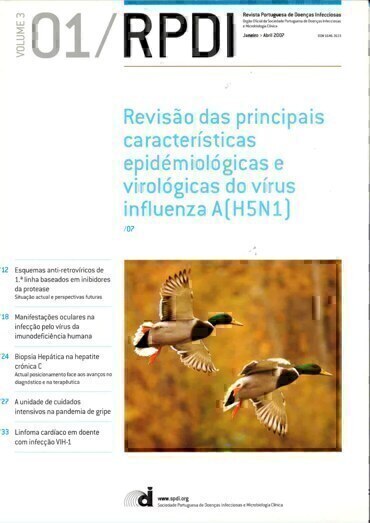
Review of the Main Epidemiological and Virological Characteristics of Influenza A(H5N1) Virus
DOI:
https://doi.org/10.65332/rpdi.v3.297Keywords:
Influenza virus A(H5N1), Epidemiology, epizootyAbstract
Influenza virus A(H5N1) has become enzootic on domestic poultry from some regions of southeast Asia, where it forms several lineages that reflect the different evolutive branches related with the geographic space where they circulate. Also, they have been associated to extensive epizootic in domestic and wild poultry, which have spread without precedent. These episodes are related with sporadic cases and clusters of severe disease in humans, mainly caused by zoonotic transmission of the virus. In this article, a review of the main epidemiologic and virologic characteristics of the A(H5N1) virus is presented, focusing on the following aspects: virus evolution; demographic and epidemiological characteristics of the confirmed cases of human infection by this virus; main transmission routes to man; incubation and transmissibility periods; determinants of human infection by the avian A(H5N1) virus and the main determinants of virulence.
References
Rebelo-de-Andrade H. Introdução aos conceitos de gripe sazonal, gripe pandémica e de gripe aviária. In Rebelo-de-Andrade et al, Gripe sazonal, de transmissão zoonótica e pandémica. Diagnóstico Laboratorial. INSA, 2006, pg. 5-9.
Chen H, Smith G, Li K, Wang J, Fan X, Rayner J, Vijaykrishna D, et al. Establishment of multiple sublineages of H5N1 influenza virus in Asia: Implications for pandemic control. Proc Natl Acad Sci U S A 2006;103 (8):2845-2850.
Alexander D. An Overview of the Epidemiology of avian influenza. Vaccine 2006; Nov 9 [Epub ahead of print].
Juckett G. Avian influenza: preparing for a pandemic. Am Fam Physician 2006;74(5):783-790.
Webster R, Peiris M, Chen H, Guan Y. H5N1 outbreaks and enzootic influenza. Emerg Infect Dis 2006; 12(1):3-8.
WHO Global Influenza Program Surveillance Network. Evolution of H5N1 avian influenza viruses in Asia. Emerg Infect Dis 2005; 11(10):1515-1521.
Jong M, Hien T. Avian Influenza A(H5N1). J Clin Virol 2006; 35 (1):2-13.
Chen G, Chang S, Mok C, Lo Y, Kung Y, Huang J, Shih Y, et al. Genomic signatures of human versus avian influenza A virus. Emerg Infect Dis 2006; 12(9):1353-1360.
Smith G, Naipospos T, Nguyen T, Jong M, Vijaykrishna D, Usman T, et al. Evolution and adaptation of H5N1 influenza virus in avian and human hosts in Indonesia and Vietnam. Virology 2006; 350 (2):258-268.
WHO. Weekly Epidemiological Record, 9 February 2007.
Wong S, Path M, Yuen K. Avian Influenza Virus Infections in Humans. Chest 2006; 129 (1):156-168.
Thompson C, Barclay W, Zambon M, Pickles R. Infection of human airways epithelium by human and avian strains of influenza A virus. J Virol 2006;80(16):8060-8068.
Lewis D. Avian Flu to Human Influenza. Annu Rev Med 2006;57:139-154.
Krug R. Clues to the virulence of H5N1 viruses in humans. Science 2006; 311 (5767):1562-1563.
Downloads
Published
Issue
Section
License
Copyright (c) 2007 Helena Rebelo-de-Andrade (Autor)

This work is licensed under a Creative Commons Attribution 4.0 International License.


