
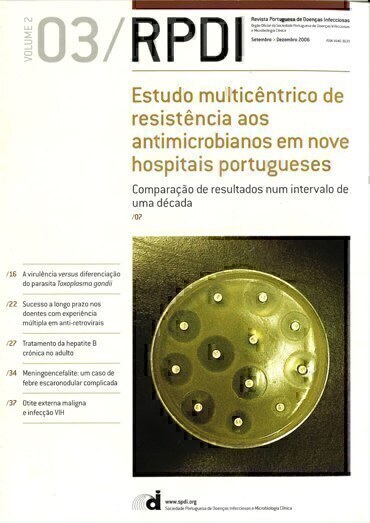
Multicentre Study of Antimicrobial Resistance in Nine Portuguese Hospitals
Comparison of Results Over a Ten-Year Period
DOI:
https://doi.org/10.65332/rpdi.v2.291Keywords:
Antibiotic ResistanceAbstract
Antimicrobial susceptibility of the most frequently isolated bacteria in clinical bacteriology laboratories was studied in nine Portuguese hospitals in 2003. Ciprofloxacin resistance was detected in 23.4% Escherichia coli isolates (c. 11000 were tested), 18% Klebsiella (c. 2850), 17.5% Proteus mirabilis (c. 1850) and 18.1% Enterobacter (c. 1180) isolates. Resistance to ceftazidime or cefotaxime, suggesting extended-spectrum beta-lactamase production, was found in 6% E. coli, 23.9% Klebsiella and 2.4% P. mirabilis isolates. Among Pseudomonas aeruginosa isolates (c. 5880) resistance levels ranged between 10% and 30% with respect to all antimicrobials tested. Very high levels of resistance were detected in Acinetobacter baumannii isolates (c. 1360), higher than 80% for all antimicrobials tested except tobramycin (25.7%) and amikacin (44.1%). Methicillin resistance in Staphylococcus aureus (c. 7000) was high (47.5%), although significant differences were found among hospitals. In the coagulase negative species Staphylococcus epidermidis (c. 2880) and Staphylococcus haemolyticus (c. 530) methicillin resistance was even higher, 76.9% and 84.0% respectively. No vancomycin resistance was detected among staphylococci. In Enterococcus faecalis (c. 2700) ampicillin resistance was low (1.5%) and vancomycin resistance was 3.5%. In contrast, in Enterococcus faecium (c. 620), ampicillin resistance was 85.7% and vancomycin resistance 31.8%. The comparison of these results with those obtained in 1993 and 1994 in the same hospitals shows a sharp increase in quinolone resistance and lower gentamicin resistance levels among Enterobacteriaceae, and the upsurge of resistance to 3rd generation cephalosporins in E. coli and P. mirabilis. Among Gram-positive bacteria, the high levels of methicillin resistance in staphylococci persisted and among enterococci there was an increase in vancomycin resistance.
References
Melo Cristino, J., Alves, A.F., Calado, E., Costa, D., Costa, M.N., Ferro, L., Correia da Fonseca, Lito, L., Marques, J., Marques, T., Sarabando Moreira, J., Ramos, M.H., Ribeiro, C.G., Ribeiro, G., Salgado, M.J. Microorganismos isolados em laboratórios hospitalares portugueses. Experiência de sete hospitais centrais. Rev. Port. D, Infec. 1994; 17: 147-154.
Melo Cristino, J., Calado, E., Costa, Calheiros J.M., D., Costa, M.N., Diogo, J., Felício, M.L., Ferro, M.L., Correia da Fonseca J. Guimarães, M.A., Lito, L., Marques, J., Marques, M.T., Martins, F., Pais, M.A., Pinto, M., Ramos, M.H., Ribeiro, G., Rodrigues, L.A., Salgado, M.J., Simões, J., Sobral, M.L., Toscano, C. Estudo multicêntrico de microrganismos isolados e de resistência aos antimicrobianos em dez hospitais portugueses em 1994. Acta Méd. Port. 1996; 9: 141-150.
Conceição, T., Faria, N., Lito, L., Melo Cristino, J., Salgado, M.J., Duarte, A. Diversity of chromosomal AmpC beta-lactamases from Enterobacter cloacae isolates in a Portuguese hospital. FEMS Microbiol. Lett. 2004; 230:197-202.
Correia, M., Boavida, F., Grosso, F., Salgado, M.J., Lito, L.M., Melo Cristino, J., Mendo, S., Duarte, A. Molecular characterization on a new class 3 integron in Klebsiella pneumoniae. Antimicrob. Agents Chemother. 2003; 47:2838-2843.
Duarte, A., Boavida, F., Grosso, F., Correia, M., Lito, L.M., Melo Cristino, J., Salgado, M.J. Outbreak of GES-1 beta-lactamase-producing multidrug-resistant Klebsiella pneumoniae in a university hospital in Lisbon, Portugal. Antimicrob. Agents Chemother. 2003; 47: 1481-1482.
Bradford, P.A. Extended-spectrum beta-lactamases in the 21st century: characterization, epidemiology, and detection of this important resistant threat. Clin. Microbiol. Rev. 2001; 14: 933-951.
Ruiz, J. Mechanisms of resistance to quinolones: target alterations, decreased accumulation and DNA gyrase protection. J. Antimicrob. Chemother. 2003; 51: 1109-1117.
Wise, R. Maximizing efficacy and reducing the emergence of resistance. J. Antimicrob. Chemother. 2003; 51: Suppl. 1: 37-42.
Van Looveren M., Goossens, H. and the ARPAC Steering Group. Antimicrobial resistance of Acinetobacter spp. in Europe. Clin. Microbiol. Infect. 2004; 10: 694-704.
Silva, G., Correia, M., Semedo, T., Quaresma, J., Lito, L.M., Melo Cristino, J., Salgado, M.J., Araújo, O., Chantre, O., Marques, J., Pessanha, M.A, Martins, F., Peixe, L., Tenreiro, R., Duarte, A. Caracterização genotípica de uma estirpe endémica de Acinetobacter baumannii: disseminação intra e inter-hospitalar. Rev. Port. D. Infec. 2005 (em publicação).
Chang, S., Sievert, D.M., Hageman, J.C., Boulton, M.L., Tenover, F.C., Downes, F.P., Shah, S., Rudrik, J.T., Pupp, G.R., Brown, W.J., Cardo, D., Fridkin, S.K., for the vancomycin-resistant Staphylococcus aureus investigative team. Infection with vancomycin-resistant Staphylococcus aureus containing the vanA resistance gene. N. Engl. J. Med. 2003; 348: 1342-1347.
Stefani, S., Varaldo, P.E. Epidemiology of methicillin-resistant staphylococci in Europe. Clin Microbiol Infect 2003; 9: 1179-1186.
Couto, I., Melo-Cristino, J., Fernandes, M.L., Garcia, T., Serrano, N., Salgado, M.J., Torres-Pereira, A., Sanches, I.S., de Lencastre, H. Unusually large number of methicillin-resistant Staphylococcus aureus in a Portuguese hospital. J. Clin. Microbiol. 1995; 33: 2032-2035.
Oliveira, D., Santos-Sanches, I., Mato, R., Tamayo, M., Ribeiro, G. Costa, D. de Lencastre, H. Virtually all methicillin-resistant Staphylococcus aureus (MRSA) infections in the largest Portuguese teaching hospital are caused by two internationally spread multiresistant strains: the "Iberian" and the "Brazilian" clones of MRSA. Clin Microbiol Infect 1998; 4: 373-384.
Amorim, M.L., Aires de Sousa, M., Sanches I.S., Sá-leão, R., Cabeda, J.M., Amorim, J.M., de Lencastre, H. Clonal and antibiotic resistance profiles of methicillin-resistant Staphylococcus aureus (MRSA) from a Portuguese hospital over time. Microb. Drug Resist. 2002; 8: 301-309.
Bonten, M.J., Willems, R., Weinstein, R.A. Vancomycin-resistant enterococci: why are they here, and where do they come from? Lancet Infect. Dis. 2001 5: 314-325.
Goosens, H., Jabes, D., Rossi, R., Lammens, C., Privitera, G., Courvalin, P. European survey of vancomycin-resistant enterococci in at-risk hospital wards and in vitro susceptibility testing of ramoplanin against these isolates. J. Antimicrob. Chemother. 2003; 51: Suppl. 3: 5-12.
Downloads
Published
Issue
Section
License
Copyright (c) 2006 J. Melo-Cristino, A. F. Alves, J. M. Amorim, J. Diogo, L. M. Lito, P. Lopes, J. Marques, T. Marques, F. Martins, L. Monteiro, I. Nascimento, M. A. Pessanha, J. Piedade, M. H. Ramos, G. Ribeiro, A. Rodrigues, M. J. Salgado, L. Sobral, O. Spencer (Autor)

This work is licensed under a Creative Commons Attribution 4.0 International License.


