
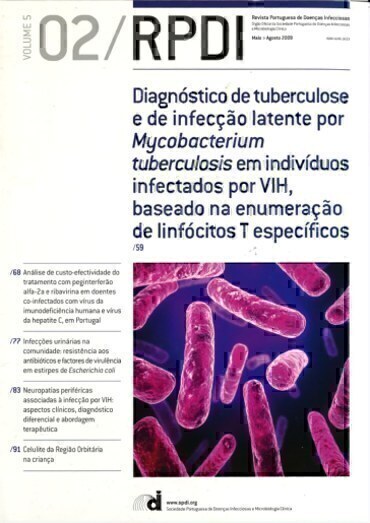
Urinary community acquired infections: antimicrobial resistance and virulence factors among Escherichia coli strains
DOI:
https://doi.org/10.65332/rpdi.v5.166Keywords:
Urinary tract infection, community, Escherichia coli, quinolone resistanceAbstract
Introduction: Urinary Infections are among the most frequent community acquired infections and Escherichia coli isolates are the main etiological agent for these infections. Aim: The purpose of this study was to identify the risk factors of community acquired urinary tract infections caused by this type of strains. Method: A total of 1831 E. coli quinolone resistant isolates from community acquired urinary infections were obtained from 55 Clinical Analysis laboratories located in different regions of Portugal. The samples were collected from January to November 2007 and studied according patient’s risk factor and antimicrobial susceptibility. A total of 150 strains were screened for genetic regions coding for fimbrial adhesions. Results: The most frequent conditions associated to this resistance were: female sex (76.2%), 60 years old (74.5%), history of recurrent UTI (25.5%) and inpatients from community healthcare units (4.4%). The prevalence rate was 16.1%, with variation between regions ranging from 21.6% to 3.8% for Lisboa and Açores, respectively. The fluorquinolone resistance was associated to sulfamethoxazole/trimethoprim (55%). Fosfomycin and Nitrofurantoin resistance rates were lower, 2% and 9.8%, respectively. The adhesion coding gene fim H was the most prevalently detected followed by papC gene in susceptible strains isolated from noncomplicated cystitis. Conclusion: In order to optimise empirical UTI treatment it is necessary to know the patterns of antibiotic resistance in different geographic locations.
References
Franco A. "Recurrent urinary tract infections". Best Practice & Research Clinical Obstetrics & Gynaecology 2005; 19 (6):861-873. DOI: https://doi.org/10.1016/j.bpobgyn.2005.08.003
Jacobsen SM, Stickler DJ, Mobley HLT, Shirtliff ME. "Complicated Catheter- Associated Urinary Tract Infections Due to Escherichia coli and Proteus mirabilis". Clinical Microbiology Reviews 2008; 21:26–59. DOI: https://doi.org/10.1128/CMR.00019-07
Johnson DE, Lockatell CV, Russell RG, Hebel JR, Island MD, Stapleton A, Stamm WE, Warren JW. "Comparison of Escherichia coli strains recovered from human cystitis and pyelonephritis infections in transurethrally challenged mice". Infect Immun 1998; 66 (7):3059-65 DOI: https://doi.org/10.1128/IAI.66.7.3059-3065.1998
Ronald A. "The etiology of urinary tract infection: traditional and emerging pathogens". The American Journal of Medicine 2002; 113: 14-19. DOI: https://doi.org/10.1016/S0002-9343(02)01055-0
Johnson JR. "Microbial virulence determinants and the pathogenesis of urinary tract infection". Infectious Disease Clinics of North America 2003; 17:261-278. DOI: https://doi.org/10.1016/S0891-5520(03)00027-8
Nicolle LE. "Urinary tract infection in long-term care facilities". Infect. Control and Hospital Epidemiol 2001; 22 (3):167-175. DOI: https://doi.org/10.1086/501886
Gupta K, Hooton TM, Stamm WE. "Increasing Antimicrobial Resistance and the management of uncomplicated community-acquired urinary tract Infections". Annals of Internal Medicine 2001; 135(1):41-50. DOI: https://doi.org/10.7326/0003-4819-135-1-200107030-00012
Lautenbach E, Fishman N, Bilker W, Castiglioni A, Metlay J, Edelstein P, Strom B. "Risck factors of fluorquinolones resistence in nosocomial Escherichia coli and Klebsiella pneumoniae infections". Archives of Internal Medicine 2002; 162:2469-2477. DOI: https://doi.org/10.1001/archinte.162.21.2469
Hooton TM, Levy SB. "Antimicrobial Resistance: a plan of action for community practice". American Family Physician 2001; 63(6):1087-1096.
Mulvey MA. "Adhesion and entry of uropathogenic Escherichia coli". Cell Microbiol 2002; 4:257-271. DOI: https://doi.org/10.1046/j.1462-5822.2002.00193.x
Piatti G, Mannini A, Balistreri M, Schito AM. "Virulence facors in urinary Escherichia coli strains: phylogenetic background and quinolone and fluoroquinolone resistance". J Clin Microbiol 2008; 46: 480-487. DOI: https://doi.org/10.1128/JCM.01488-07
Downloads
Published
Issue
Section
License
Copyright (c) 2009 V. Rodrigues, T. Hänscheid, J. Melo Cristino, A. Duarte, Grupo de Estudo Português de Bactérias uropatogénicas da comunidade (Autor)

This work is licensed under a Creative Commons Attribution 4.0 International License.


